The present article forms part of our response to the call issued by the late Fr. John Romanides to the Romeoi and the Romaïgisses (as Makrygiannis calls them) to take up the struggle for the resurrection of Romeosyne from the death “which others have wrought for her.”
All around us we observe a profound decline. Our country, our society, our Genos (sic) moves from crisis to crisis, from dead end to dead end, from decay to decay. Such is the disappointment and despair of the people that we often reach the point of nihilism. Orientation is missing; the core is missing; the truth of who we are and who we can become is missing; the vision is missing.
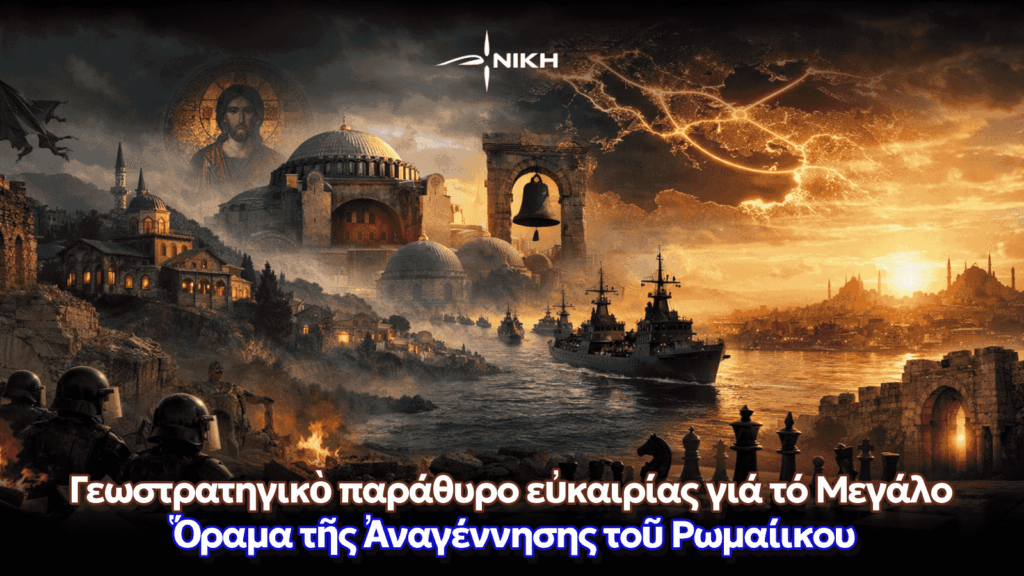
As a people, we need a vision—a great vision that will gather us together once again. Not “growth,” not “improvement,” not “management.” We need a vision that is holistic, existential, historical, and civilizational. Such a great vision is the vision of the Resurrection of our Genos, with Romeosyne as its axis and the reunification of the Romeiko world as its goal. The vision of the Rebirth of the Romeiko does not invoke myths; it springs from and emerges out of historical truth, from our ecclesial tradition, from the very identity of our Genos—the Genos of the Romeoi. Precisely there lay our distinctiveness, our strength, our unity, and our ecumenical and eschatological proposal of life to the world.
Romeosyne was never a “monophysite” civilization; it always affirmed the world. The Rebirth of the Romeiko is not a vague slogan; it is a strategic plan built upon four pillars and, at the same time, the only realistic way out of the historical tomb prepared for us.
I. The Fermentation of the Greek People with the Idea of Romeosyne
The first and indispensable step is the restoration of memory within our people. We must reinterpret our history and approach our identity using our own interpretive keys, not those of the West, of Frankdom. We must transcend the fragmentary mosaic of antiquity–modernity and rediscover our distinctiveness within our true civilization: our Romeosyne, the Romeiko way of life, ecclesial experience, and the ecumenical polity that once united peoples from the Balkans to the Middle East.
This must be a spiritual, political, and cultural fermentation of the people, and above all a lived, existential one. Not merely a change of mindset, but a change of life—one that will be inscribed upon the body, upon existence itself, upon one’s stance toward life, imbued with a spirit that is militant, hesychastic, ascetic, and doxological. It is a difficult undertaking, since the modern Greek not only perceives reality through Western lenses and often descends into nihilism and complete indifference—having lost what is sacred according to our own tradition—but because his very way of life has been profoundly altered, falling into sterile passivity and submission.
II. The Fermentation of the States Descended from Historical Romanía
The peoples who once lived this shared tradition, this common civilization of Romeosyne, now find themselves fragmented—according to the dictates of successive Great Powers—into small, fully controlled nation-states, often even in tension with one another. And yet the common Romeiko core still exists: in our shared historical journey, in the common memory of our capital, Constantinople, in our Orthodoxy, in our liturgical ethos, in our shared understanding of life.
In the name of safeguarding the human person, and in the face of the dense darkness of multiple forms of unfreedom being engineered for us on a global scale, it is worth reuniting our forces. The Romeike tradition was never nationalism; it was brotherhood within a common Romeike polity.
This requires long-term fermentation, the creation of political bodies animated by such a vision, and multiple economic, political, cultural, and strategic collaborations. The ultimate goal is the political unification of the states descended from historical Romanía, whatever form that may ultimately take—from an initial alliance, to a confederation, a federation, or even full union.
III. Assistance to the Asia Minor Populations in Rediscovering Their Origin
The majority of today’s inhabitants of Asia Minor are Islamized Christians—Islamized Romeoi. Their grandparents spoke Romeika (Rumca), had churches, baptized their children, and many remained crypto-Christians until the twentieth century. The question of their identity has already been opened within Turkey itself (kimlik meselesi). They thirst for truth. They seek roots. They discover that they do not descend from Mongols or Central Asians, but from the Romeoi of Pontus, Cappadocia, Phrygia, Bithynia, and the Balkans.
We have a duty to help these people see before them not enemies, but their own brothers. Through books, websites, audiovisual material, conferences, contacts, friendship, and truth.
IV. Connection with the Millions of Romeoi of the Middle East and Their Diaspora
The Romeoi of Syria, Palestine, Lebanon, and Jordan—those who remained faithful to Orthodoxy—are also part of the same body. Alongside them stand their communities in the Diaspora, in America, Australia, Europe, and across the world. These are people persecuted and isolated for many centuries, and yet they preserved—and continue to preserve—intact and unaltered their authentic historical identity, thereby constituting for all of us a living testimony of our historical truth.
They are an inseparable part of the Romeiko body, and every form of assistance to them has profound meaning—from the multifaceted strengthening of their communities to the granting of expatriate (homogeneis) status.
There is also a fifth pillar, not yet fully visible: the re-emergence of the truly Romeiko civilization that still exists and quietly smolders in the depths of the soul of the European and Euro-descended human being—a Romeiko civilization buried for centuries beneath the heavy tombstones of Frankdom and the Papacy that followed it. Dead ends will lead to searching; searching will reveal historical truth; and truth, in turn, will bring change. But this is not yet fully visible.
Four pillars, therefore—four axes for the Rebirth of the Romeiko. No, we are not a small country, a small Greece, a small entity. We are an entire world awaiting the rediscovery of its multifaceted, God-bearing identity in freedom, for the sake of the universal human being. And this visionary stance will powerfully re-infuse the hearts of our people along their radiant journey toward the last things.
Ioannis Kon. Neonakis
Head of the Romeosyne Policy Department of NIKI
Notes: (a) The term “Romanía” (with an accent on the í to distinguish it from the modern state of Romania) is the correct designation for the Roman Empire after the transfer of its capital, instead of the erroneous and deliberately employed term “Byzantium”.
(b) For reasons of more accurate phonological rendering and simplification, the term “Romeoi” was preferred over “Rhomaioi”.
(c) The term “Romeosyne” was preferred over “Romanitas”, as it better expresses the culture of the Roman Empire after the prevalence of Christianity.
(d) romeike (adjective): of the Romeoi.
(e) Romeiko (noun): the romeike world, the romeike body.