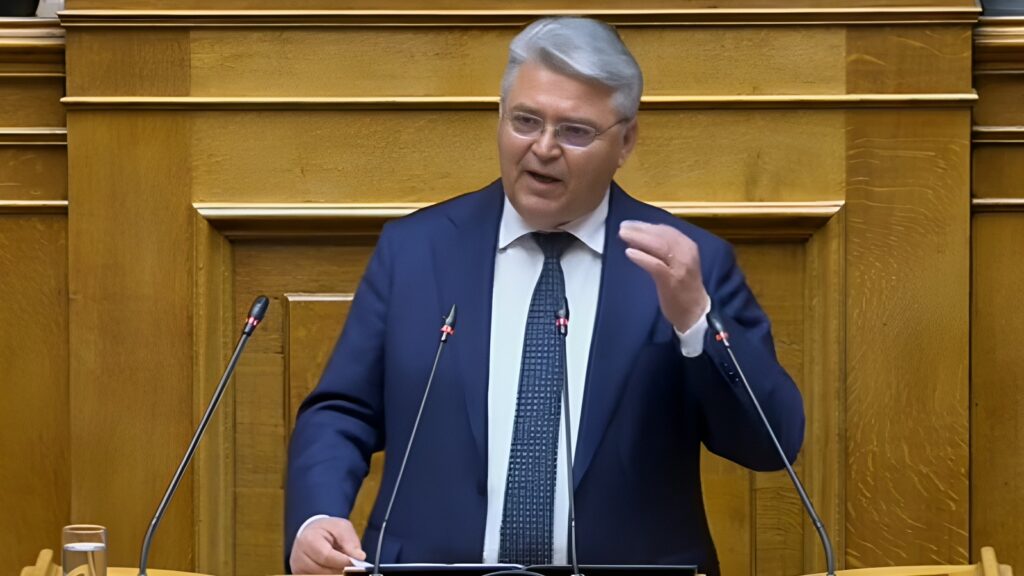
European Member of Parliament for the Greek political party “NIKI” – Nikos Anadiotis – had organized in the European House of Parliament on December 9th of 2024, an event on the theme: “An Orthodox Proposal for Life: The Philokalian Person” (1).
The pursuant thoughts are intended to touch on this topic.
***
The religion-less character that the European Union has embraced is absolutely contrary to the Christian spiritual roots of Europe.
This character happens to also be driven by a “defensive” spirit that has led -for example- to activities by political groups, for the exclusion of religion from public life, (2) while abundant phenomena of “Christianophobia” have also been observed in various European countries – such as racist behavior towards people who publicly express their Christian beliefs. This phenomenon is mainly attributed to the unhealed wounds inflicted on Western societies by “Christian” representatives who have been dominating them over the last thousand years. The horrific “Middle Ages”, as well as colonialism, the religious wars, moralism and many other ugly experiences, have hurt and continue to hurt the Western European so much, that they felt forced to dispose of the Christian religion that was imposed on them like a heavy quilt.
However, Western European brethren are not aware that all the “versions of Christianity” which have dominated the Western European world for the last thousand years – in the Roman Catholic and Protestant areas – are clearly heretical and are essentially deviations from the authentic teaching and life of the original Church that was founded by Jesus Christ, in all its basic points (3).
This deviation is not theoretical: God was perceived as a cruel dictator, man was underestimated and annihilated; he was excluded from the possibility of union with God (which constitutes salvation – which Christ came to actualize) and he was made to feel like an accused before Him; the Church was separated from the people and had assumed absolute authority over the people – as did the pope, over the entire Church. The Middle Ages with all its pathology is a product of these deviations, the consequences of which continue to this day.
It is self-evident that the teaching of Jesus Christ about love for one’s neighbor has nothing to do with fanaticism, cruelty, pietism and moralism, which –sadly- Western Europeans have come to believe as characteristics of Christian religiosity. Unfortunately they do not know – although some are slowly discovering it – that the authentic, primordial Church that He founded – the Church of indigent apostles and martyrs, spiritual fighters and open-minded teachers of love – has never ceased to exist. It existed and continues to exist – just a breath’s distance from their homes. It is the Orthodox Church.
Impacted by the judgments of prejudiced scholars, mainly the much earlier ones, about the historical space of Orthodoxy, most Western Europeans probably identify Orthodoxy with imperial Byzantine machinations or with tsarist feudalism. But Orthodoxy does not in the least identify with them. On the contrary, the true, holy, Orthodox teachers fought against injustice and oppression, wherever it may have come from. Orthodoxy also does not identify with any rich and powerful ecclesiastic establishment that “manages” people’s faith and superstitions. The Body of Christ (the Church) consists of God’s people, – of all people, clergy and laity, men and women, children and adults, rich and poor, educated and illiterate, rulers and workers, even virtuous and sinful, brave and cowardly, believers and unbelievers, are invited to unite on par with fellow man, with Jesus Christ, with the Triune God, and by extension with all beings, and to reach (while still living, not just ‘after death’) the most perfect possible spiritual state: to become ‘gods by grace’ – that is, saints – and to reign with Christ in His eternal Realm.
It is a way of life, which, when followed with seriousness and consistency, leads man to the healing of his soul from the passions (that is, from whatever causes him dependency) and the establishment within him of humble and selfless love for all people and all beings. All the elements that this way of life contains, such as confession, Holy Communion, prayer, fasting, but also the practice of the virtues, exist to help man walk this path – the path that Christ Himself had taught.
Historically, hundreds of thousands of people of every era have progressed spiritually along this path and have become saints. Of course, not even in traditionally Orthodox nations do all people follow this path, especially in our time, as the ideological currents of the West are spreading through all the lands (including Greece), making spiritual confusion spread more and more. However this path is a fundamental element of our civilization and is followed even today by many; in fact, it is also being discovered by increasingly more people.
Important holy teachers of the 20th century, as well as Orthodox thinkers (from St. John Maximovich to St. Sophrony of Essex; of the fathers and academics, George Florovsky and John Romanides to Fr. Nicholas Loudovikos and several others from Western countries are also mentioned below), have enriched recent bibliography with exceptional works, which can now inform the reader about the authentic character of Orthodoxy.
In Western Europe, ‘liberation from religion’ was inevitably not accompanied by any moral progress, nor, of course, by the acquisition of happiness. Even today the world is ruled by the potentates of wealth, while the laity is sinking in despair and misery – albeit in a different manner than during the era of feudalism, or even later on, during the industrial revolution. Thus, in their search for substitutes to fill the spiritual void left by the expulsion of religion, people have been resorting to new ‘opiates’, such as yoga, ecological and social activism, cultural events, the internet or social networks. The demand for freedom and justice continues to plague Western Europe, exactly as it did during the Age of “Enlightenment”. Just as a West European person does not suspect that the “Christianity” of his medieval ancestors is a mosaic of heresies, he likewise does not suspect that in the past, more than a thousand years (before the Great Schism of 1054), Western Europe was an Orthodox Christian continent.
Nowadays many assert that we share a “common religious heritage” of the first thousand years of Christianity together with the “Roman Catholic Church”. Unfortunately, this is untrue. Although it is self-evident that in the Roman Catholic world (as in many other religions) many commendable personalities have emerged – full of sincerity and love – the truth is that the “Roman Catholic Church” is the rejection and the negation of the authentic Christian origins. Orthodoxy indeed has a common religious tradition with Western Europe – but of the early Christian centuries – however, contemporary Western Europe did not continue to pursue this tradition.
In their past, Western European peoples had hundreds of their own saints, ascetics, martyrs, spiritual fighters and teachers, who were Orthodox saints, ascetics, fighters, etc. (4), whose spiritual heritage was disregarded when Catholicism dominated the Western European territories, altering Christianity from a path of love, healing, self-knowledge and holiness, into an oppressive superstition.
Thus arises a strong and urgent necessity, not only for the discovery by Western European brethren of their ancient Christian roots, but more importantly for their return to them.
This return is regarded as necessary and urgent, for serious reasons such as:
A) Orthodoxy is the authentic, original European spiritual heritage, the one that can offer every European inner peace, self-knowledge and joy and can also heal wounds, both of individuals and of society. The constant and uncompromising struggle of the holy Fathers and Teachers of Orthodoxy for fellow-man is evidence of a treasury of spiritual energy which drives a person to action: action that is motivated by love and forgiveness (also providing all the means necessary for their acquisition and cultivation), not hatred, nor the relentless demand for justice or the thirst for revenge.
B) Regardless of individual beliefs, it must be reassured with awareness and honesty that Orthodoxy is the path for man’s union with God, through Christ – a union that also constitutes the union of love for one another – among people, and with the whole of God’s creation – of all beings.
In our day and age, what Western man is seeking from within the pantheism of Native Americans or the Shamans or the mystical practices of Buddhism and Hinduism (i.e., harmony with the self and with the almost obliterated -by their own civilization- natural environment to become ‘one with creatures’), is actually the heart of their true spiritual Tradition, which they had abandoned ages ago – even though in close proximity, the neighboring Orthodox countries had never abandoned that original Tradition. More accurately, it was never entirely abandoned, because (indicatively), Greek societies had suffered serious defeats (including spiritual ones) from Western expansionism, and their losses were heavy. But, thank God, holy people still exist, in the streets of their cities, in their villages, in their forests, as well as in their monasteries.
C) The truly common, original Christian Tradition of Europe – which is a unifying factor for the European peoples of East and West – is Orthodoxy. Orthodoxy unites the peoples of Eastern Europe and it should be acknowledged as the most precious treasure. It also unites them with the peoples of the West. Without Orthodoxy – if one may say so – in essence it will be very difficult to find connecting links with the West.
The history of the last centuries has been separating East from West, whereas Orthodoxy only connects them.
The ideas and practices of the Franks -and later of Catholicism- had been condemned as heretical by the Ecumenical Councils of 879-880 and 1341 (which are regarded by some to be the 8th and 9th Ecumenical Councils respectively), while a direct and analytical condemnation of the papal heresies can be found in the 1848 Council of the Patriarchates of the East, and of course in a large number of individual holy Fathers and Teachers of Orthodoxy – from Saint Mark of Ephesus to contemporary Saint Justin Popovich – and even Westerners, such as Popes John VIII, who participated in the Council of 879-880, and also Leo III. Hence, it is not a question of whether Catholicism perhaps “is not a heresy”; this fact is also revealed by common sense: a simple comparison of Catholicism’s history with the Gospel (with shining exceptions, as already mentioned above) is enough to reveal the vast gulf that separates them.
The same applies to the Protestant sphere and of course to the Pentecostals and the so-called ‘born again’ or the ‘charismatic Christians’ (groups that fall into a trance and believe that ‘the Holy Spirit’ enters them and leads them into various prophetic and miraculous situations) – all of which have practically nothing in common with the Orthodox – the exception being their invocation of a general faith in Christ (5).
However, the necessity for the return of the Western Europeans to their Orthodox roots by no means implies a return ‘to us‘ – to a specific ‘Orthodox embrace’ – since all human beings likewise need a return to Christ. It means exactly what was said previously: a return to one’s proper self. The West may have discovered “human rights” for every person and citizen, for all ages, for both genders, at educational and economic levels… as well as for the rights of animals, plants and the planet itself (which are often inspired by pagan or pantheistic cultures of other civilizations). However, it was not the West which had discovered the way for man to transcend passions and show respect (in practice) to the aforementioned rights of others, nor the path (through that said respect) that leads mankind to its divine destination. Of course the West remains unaware of the (existing) sources of inspiration on these issues by which it can be guided: that is, by the lives and teachings of (even its own) ancient saints, the unified and Orthodox Western saints, with their particular cultural characteristics, but nonetheless belonging to the universal Orthodox Church.
In recent years, a number of spiritual seekers have appeared in the Western world, who are discovering the ancient Christian Church – Orthodoxy – and finding the confidence to join it. To mention some examples: the Spanish Franciscan monk Paul de Ballester Convalier (who was murdered in Mexico in 1984, after having been ordained an Orthodox bishop); the French monk Fr. Placide Deseille; the French Professor of Patrology Jean-Claude Larchet (author of the work The Healing of Spiritual Diseases, in which he highlights the therapeutic character of Orthodoxy); the English professor of the University of Oxford and Bishop of Diokleia, Fr. Kallistos Ware; the Swiss theologian and monk Fr. Gabriel Bunge; the American philosopher Fr. Seraphim Rose; the well-traveled spiritual seeker Klaus Kenneth, e.a.. Of course, there are thousands more examples. A particularly characteristic case is of a Protestant Confession in the USA, which returned to Orthodoxy in the 1980s in its entirety, together with its priests and bishops, after their meticulous research into the ancient sources of Christianity. Their history is recorded by their bishop, Fr. Peter Gilquist, in his book “Becoming Orthodox”.
Albeit beyond Europe, it is worth mentioning that in Latin America there has been a movement towards Orthodoxy of hundreds of thousands of people in recent years, especially in Guatemala, who have departed from Catholicism and the “charismatic movement” sphere.
This is Europe’s future. With sincere love and respect for everyone, it must be stressed that outside of Orthodoxy – even in the noblest, atheistic, humanitarian activisms, or in the wanderings through the streets of ancient European paganism, of magic, and of Asian mysticism, hell rages, relentlessly: the personal hell of loneliness, despair, depression, and the social hell of the domination of the neo-colonialist giants of Economy, who manage the fate of all the peoples – not just in a certain continent, but in the entire planet.
Theodoros I. Riginiotis
Theologian
Head of the Thematic Group of NIKI for the Cultural
(Translation A.N.)
NOTES
(1) See “Event of MEP Nikolaos Anadiotis, on the theme ‘Orthodox Life Proposal: The Philokalic Man’”. The entire event here: https://www.youtube.com/watch?v=WDRmnbfozi0.
(2) Various related news articles:
•Isabel Vaughan-Spruce: Arrested for silent prayer
•Woman paid £13k after silent prayer arrest
•Silent prayer outside abortion clinics to be banned under new law
•2024 Annual Report – United Kingdom Section
•Army veteran convicted for silent prayer near abortion clinic
•BBC News: Silent prayer arrest and settlement
•The Public Order Act 2023 – UK Legislation.
(3) Although it may be redundant for some Roman Catholic readers, there is a link by the Rev. Metropolitan Hierotheos of Nafpaktos and Saint Vlasios, here: Basic points of difference between the Orthodox Church and Papism.
(4) To name a few of the ancient saints of the West:
Irenaeus of Lyons, Clement of Rome, Hilarion of Poitiers, Martin of Rome, Gregory Dialogus, John Cassian of Autun, Ambrose of Milan, Martin of Tours, Dionysus and Genevieve of Paris, Benedict of Nursia, David of Wales, Columba of Iona, Cuthbert of Lindisfarne, Patrick of Ireland, Hilda of Whitby, Isidore and Leander of Seville, and many others…
For the Orthodox roots of the West, there are several other sources that may be of added interest to Greek speaking readers – for example in the books by Professor George Piperakis, “Η εν Ορθοδοξία Ηνωμένη Ευρώπη” (Europe United in Orthodoxy), Eptalofos publications, Athens 1997, and “Πανάγιον Ορθοδόξων Αγίων” (All-holy Orthodox Saints), Metamorfosis Sotiros publications, Milesi 2006; in the book by Christoforos Commodatus, Bishop of Telmissos, “Οι άγιοι των Βρεττανικών Νήσων” (Saints of the British Isles), Athens 1985, but also in the book by Hieromonk Damascenos, “Father Seraphim Rose – His life and Works”, Vol.B, Myriobiblos publications 2006, chapter 78 “Orthodox Roots in the West), pp.520-543.
Additional links are available at the following addresses:
-Pre-Schism Orthodox Saints of the West
-Orthodox Saints who evangelized Western Europe and Scandinavia
-Index of British & Celtic Orthodoxy
-Religion of the Celts
-Index of Biographies
-A Brief History of the Orthodox Church in the British Isles
There are also very many Orthodox sites by Metropolises and Parishes in Western European countries, including related dedications in the periodical “The Orthodox Word”, editions 64, 72 and 74 (here).
(5) On this matter one can refer to the work by Fr. Seraphim Rose, “Orthodoxy and the Religion of the Future” ed. 2011 (in full, here) and the book by Fr. Alexios of Karakalou Monastery, Holy Mountain, publ. 2006: “ In Peace Let Us Pray to the Lord: An Orthodox Interpretation of the Gifts of the Spirit” (English publication).
Related posts
-
Human, Metahuman and GodhumanDiaspora 17 July 2026