September 14, 1922, and September 6, 1955.
Two historic milestones in modern Greek history. Two instances of the tragic demise of Hellenism in Constantinople and Asia Minor.
Why should a people preserve its historical memory? It is so that their future generations may remain aware of the dangers that surround them, and so that they are prepared to confront these dangers with diligence and intelligence.
Τhe purpose of this brief commentary is not to focus on the events of 1922. So much has already been written about the Catastrophe of Smyrna. When a Greek recalls that tragedy and the massacres that accompanied it, one phrase and image comes to mind: ‘Smyrna is burning!’
The correspondent of The Guardian newspaper wrote on September 16, 1922:
“The fire was started with petroleum yesterday at midday by Turkish regular troops with the object of hiding the bodies of those massacred the night before.”
(source: www.theguardian.com/world/2022/nov/30/the-destruction-of-smyrna- archive-1922)
For a lengthy and illuminating account of the massacre of Greeks and Armenians in Smyrna in 1922, The Blight of Asia by George Horton cannot be recommended highly enough. Horton was the US Consul General in Smyrna during World War I. His book can be read online in English free of charge at www.gutenberg.org/ebooks/76324. And for further eyewitness accounts and testimonials regarding the uprooting of Hellenism in Asia Minor, one may study a wealth of material available on the excellent website greek-genocide.net
When compared with the unspeakable crimes of 1922, far less attention has been devoted to the massive and deadly riots that took place in Constantinople on September 6, 1955, perhaps because the scale of destruction was smaller. And yet, the devastation was by no means small. The Greek Ministry of Foreign Affairs records the destruction of 1,004 houses, 5,000 businesses, 73 churches, 23 schools and two cemeteries.
We may reasonably regard this not merely as an attack on ethnic Greeks and their property, but also as an assault on the remnants of Christian civilisation in what had traditionally been its heartland and stronghold: Asia Minor. Following the exchange of Christian and Muslim populations with the 1923 Treaty of Lausanne, Constantinople was the principal exception to that exchange and remained the last major centre of Greek Orthodox faithful in modern Turkey.
By 1955, and then in 1964 for other reasons, this community was brought close to oblivion with astonishing speed, as illustrated by the following estimate of the Greek Orthodox population over the past century:
Period Approximate Greek population
1923 100,000–110,000
1955 before pogrom 67,500–100,000
1955 after pogrom 48,000–80,000
1964–65 30,000–48,000
1978 7,000
2006 2,500
2008 2,000
2014 2,200–2,500
2024–26 2,000–3,000
(sources: Greek Ministry of Foreign Affairs, Ecumenical Federation of Constantinopolitans demographic chart and Alexis Alexandris, The Greek Minority of Istanbul and Greek-Turkish Relations, 1918–1974)
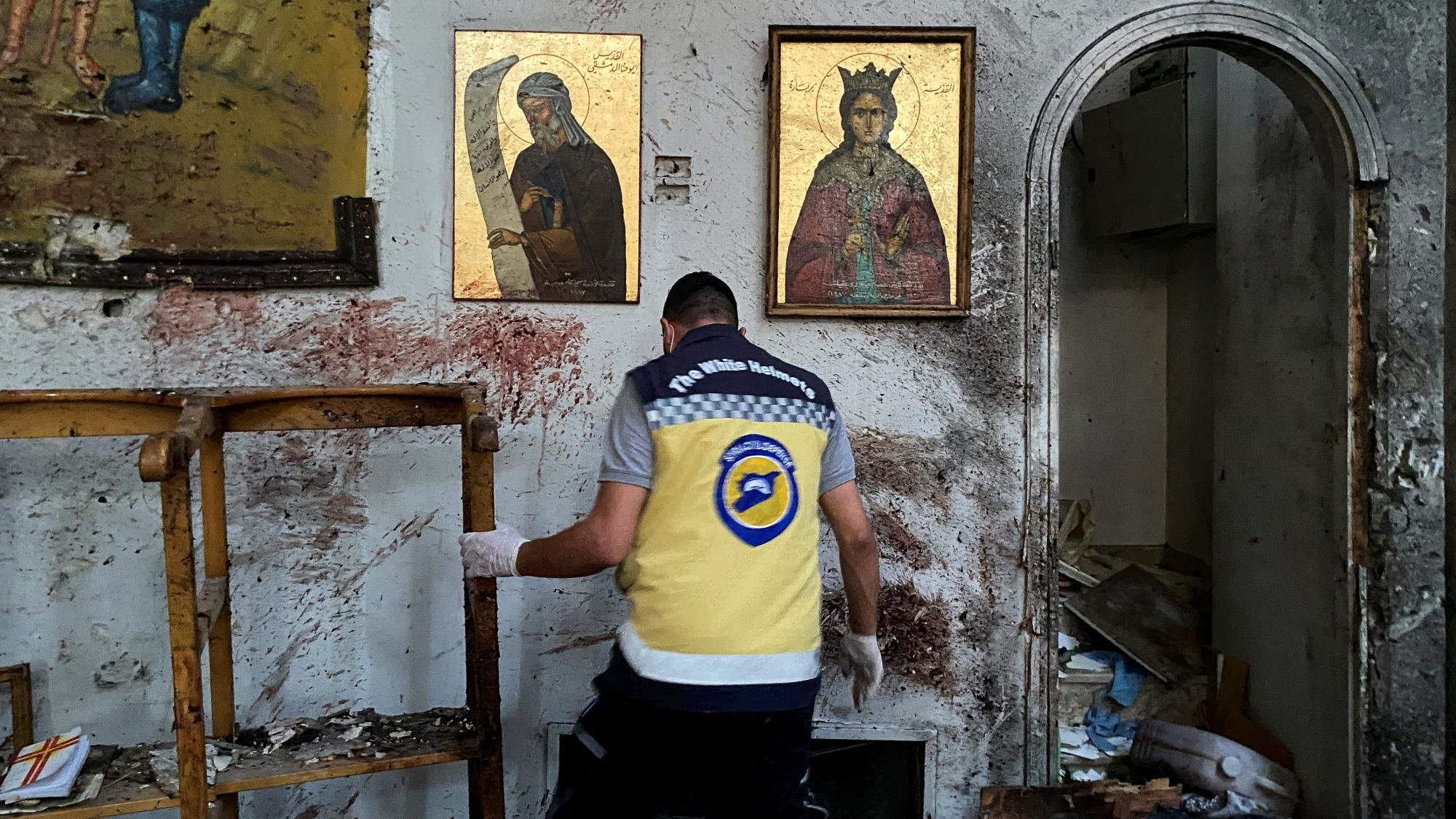
Given that the rioters deliberately targeted churches, icons and other sacred objects, schools educating Christian children and cemeteries, the events can be understood as an assault not merely on the Greek community of Constantinople, but on Orthodoxy itself.
These swift seismic upheavals of 1922 and 1955, following the massive genocide against Greeks, Armenians and Assyrians earlier in the 20th century, resulted in the removal of Christianity from the historic geographical setting in which it had existed throughout Asia Minor since the time of the Apostles.
When seen through spiritual eyes, this was evil. Seen through political eyes, it was a methodically designed and well-executed campaign carried out ruthlessly by Turkish military and civilian leaders.
The churches, schools and cemeteries were not ‘collateral damage.’ Together they constituted the very fibre and structure of the Orthodox Christian presence in Constantinople, involving worship, education and remembrance of the dead.
The pretext for the riots was a bomb attack on the Turkish Consulate close to the supposed birthplace of Atatürk in Thessaloniki that took place only hours earlier. However, the evidence indicates that an organised anti-Greek mobilisation was already being prepared in Istanbul before the bombing in Thessaloniki. The evidence also indicates that the bombing was an inside job.
The Deputy Prime Minister at the time, Fuat Köprülü, said to the Turkish National Assembly on September 12, 1955, that the bombing and the subsequent events were the work of “the same hands, the same organisation, the same systematic centre.” The bombing served as the justification for the furious mobilisation of mobs in Constantinople. Within hours (how was this achieved so quickly?), propaganda and photographs of the explosion appeared in the front pages of newspapers such as Ιstanbul Express, further inflaming violence against the Greeks.
Speros Vryonis expressed the magnitude of what occurred with remarkable succinctness:
“This historic Greek community which had lived and created in the city on the Bosphoros from its first foundation in 668 B.C. up to 1955, for some 2,623 years (some 104 generations), suffered a complete and destructive catastrophe in only seven hours.”
(source: ‘September 6, 1955: Krystallnacht in Constantinople’, https://archons.org/greek-america-magazine-reports-on-september-6-1955-krystallnacht-in-constantinople)
Finally, it is worth quoting a Turkish eyewitness, Mehmet Ali Birand, writing in the Turkish Daily News on September 7, 2005:
“I am one of the living witnesses of what happened in Istanbul 50 years ago. I was 14 years old. I did not know what it was all about. However, the passage of time made me understand the seriousness of the incidents and I always carry the shame.
We were living on Ethem Efendi Street at the time. Our neighbours were mostly Greek. They were my best friends. All of a sudden, they shut themselves in their homes. They talked to no one. I can never forget Madam Eleni when she asked, ‘Can we seek refuge in your home if they attack us?’ The barbershop she managed with her husband was in ruins. They were in shock. My mother sent them food for a week. We let them live in one of our rooms.
I was too young to make sense of what had happened. Why should they attack Madam Eleni?
The Greek families in our neighbourhood started to move to other places or go to Greece. After 1963 none of them were left. They left Istanbul. They took with them an important culture and a different lifestyle. They left us alone in Istanbul to live our colourless lives. Later on we were full of regret, but by then it was too late.
Turkey admitted all culpability. Much later, we learned the September 6-7 incidents were the doing of the infamous deep state. It was planned with government approval in order to let diplomats say that the people were reacting during the U.N. discussions on Cyprus. However, it later got out of control and turned into a shameful plunder. It became a crime that the deep state could not handle, and it shamed the Turkish nation.”
(source: https://archons.org/greek-america-magazine-reports-on-september-6-1955-krystallnacht-in-constantinople)
Greece has so many historic battles and heroes to commemorate, it seems that each individual commemoration receives much less attention than it truly deserves. Yet even when Greeks suffer massacres and the uprooting from their ancestral homelands within living memory, they seem to display an almost scandalous degree of either forgiveness or forgetfulness.
So, at the risk of sounding provocative we may ask ourselves: Is forgiveness the only remaining virtue for today’s Orthodox Christian?
Similar, if not greater, threats exist at this very hour in the Aegean and in Cyprus. Along with forgiveness, what has become of the other great quality about which the Lord advised His disciples: to be “as wise as serpents” (Matt. 10:16)?
The snake is exceptionally aware of its surroundings and capable of detecting a trap before falling into it. Neither should we be naïve about our geopolitical environment. And when under attack, as St John Chrysostom notes, the snake coils up and protects its head. For us, the head symbolises the pinnacle of all we hold to be most sacred: our altars and our homes, and they must be defended above all else.
By Dimitri Kepreotes
Member of the Romeosyne Policy Department, Democratic Patriotic Popular Movement NIKI