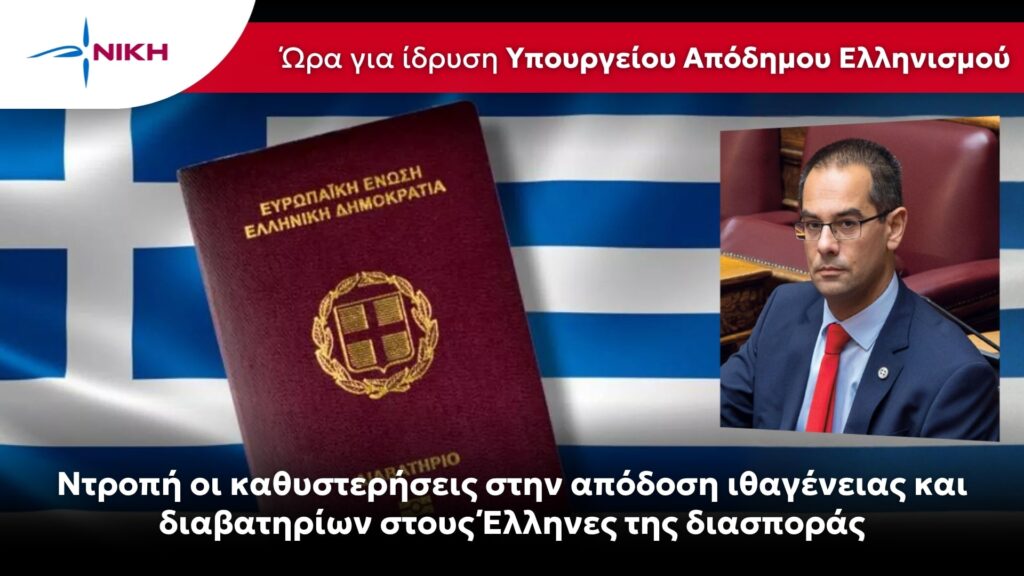
Through a parliamentary question addressed to the Minister of Foreign Affairs, Mr. Georgios Gerapetritis, the Minister of Education, Religious Affairs and Sports, Ms. Sofia Zacharaki, and the Minister of Culture, Ms. Lina Mendoni, the President of NIKI, Dimitris Natsios, places at the center of public debate an issue of strategic importance for the country: the harnessing of the Greek language as a factor of soft power and as a tool for strengthening Greece’s geopolitical position.
The occasion for this intervention is UNESCO’s historic decision to designate 9 February—the day of death of our national poet, Dionysios Solomos—as the World Greek Language Day. This decision constitutes international recognition of the universality and enduring radiance of the Greek language, which has been spoken and written continuously for 35 centuries and has played a decisive role in shaping global civilization.
The Greek language cannot be treated merely as an element of cultural heritage or as an educational subject. In an era of intense international competition over narratives and cultural influence, language constitutes a strategic advantage with clear geopolitical implications. Numerous states invest systematically in the international dissemination of their languages through organized institutions of cultural diplomacy, thereby shaping standards, values, and spheres of influence.
Special reference is made to Turkey, which methodically employs the Turkish language as an instrument of cultural and diplomatic penetration through the state-run Yunus Emre Institute, enhancing its presence in regions of strategic interest. At the same time, Greece—despite the unique global prestige of its language—lacks a unified, institutionally established mechanism for the international promotion of its language and culture.
Within this framework, the President of NIKI proposes the establishment of a National Foundation for the Greek Language and Culture, to be named “Homer”, with an international reach and strategic orientation. Such a foundation would function as an organized pillar of public diplomacy, with a network of branches in geopolitically critical countries, partnerships with universities and think tanks, and direct integration into the overall foreign policy of the state.
At the same time, he raises with urgency the issue of strengthening linguistic education within the country and across educational structures abroad. He calls for specific pedagogical and administrative interventions aimed at upgrading the teaching of the Greek language at all levels, modernizing curricula and textbooks, ensuring adequately trained educational personnel, and reintroducing elements of Ancient Greek—particularly through an etymological approach—into the final grades of primary school. He also highlights the need for the substantive reinstatement of the celebration of the Three Hierarchs as an institutional educational holiday.
The Greek language is a living bearer of culture, values, and historical continuity. It can—and must—serve as a multiplier of national strength and international influence. Dimitris Natsios’s parliamentary initiative calls upon the government to move beyond fragmented actions and to advance toward a comprehensive, serious, and long-term national strategy.
NIKI will continue to bring forward issues of strategic significance for the homeland, defending the Greek language not only as a cultural treasure, but as an active instrument of national power and international presence.