Acknowledgements
First and foremost, we wish to express our heartfelt gratitude to the members of the Romaian Cultural Society, based in Beirut, and in particular to its President, Professor Negib Elias Geahchan, as well as to Mr Nicolas Saba and Mr Gabriel Andrea, for their invaluable assistance.
Introduction
In modern European terminology, the term Levant denotes the geographical area of the Eastern Mediterranean, and more specifically its eastern shores, that is, the region comprising chiefly Syria, Lebanon, Palestine, and Jordan. The term derives from the French word levant (“east,” “the place where the sun rises”).
The name Romeoi / Romaioi (Rum) is not merely a historical designation, but a declaration of identity and continuity. It derives from Rome, initially the city in Italy, and thereafter from New Rome, Constantinople, which was founded in 330 AD by Saint Constantine the Great and served as the capital of the Roman Empire, that is, of our homeland Romanía (wrongly and deceitfully termed “Byzantium”).
Greek cities in the region of the Levant are already attested from the seventh century BC onward. Phoenicians (Canaanites) and Arameans, in continual contact and intermixture with the Greek world (populations from Cyprus, the islands of the Aegean, and Asia Minor), gradually formed a unified cultural body. During the age of Alexander the Great and the subsequent Seleucid period, Hellenization was profound and complete, with the Greek language becoming the common tongue of daily life, administration, and education, especially in the western provinces (present-day Lebanon, Palestine, and Western Syria).
Seleucus I Nicator, Alexander’s general, founded Antioch the Great, whose first settlers were chiefly Athenians and Macedonians. Antioch would become a cradle of Greek civilization, and later of Christianity, while the whole region would for hundreds of years constitute a central pillar of Romanía. To this day, Antioch remains the seat of the Orthodox Romeic Patriarchate, bearing witness to an unbroken ecclesiastical and historical continuity.
Nearly all the major cities of the Levant bore Greek names already from antiquity. Some have survived to this day, others were partially Arabized, while some were replaced by Arabic names: Ptolemais (Akko / Acre), Tyre, Sarepta (Sarafand), Sidon (Saida), Porphyreon (Jiyeh), Berytus (Beirut), Byblos (Jbeil), Botrys (Batroun), Tripolis (Tripoli), Arcadia (Arqa), Antaradus (Tartus), Aradus (Arwad), Heliopolis (Baalbek), Seleuceia (al-Suqaylabiyah), Paneas (Banias), Caesarea, and others.
When the Levant was incorporated into the Roman Empire, its inhabitants became Roman citizens, yet without losing their linguistic and cultural substratum. Greek remained the living language both of the people and of the state. This is clearly reflected in the New Testament, which was written there in the Greek language.
Christianization
Before 313 AD, Christianity remained chiefly an urban reality, embraced by a relatively small part of the population (10–20%). Yet with the appearance of Saint Constantine the Great and the historic turning point he brought about, a new era began for Romanía. The transfer of the capital to New Rome / Constantinople was not a mere administrative act, but a profound rupture that redefined the course of the Empire. This city emerged as the center of Orthodoxy, and from that point onward Romanía was no longer simply an empire, but a Christian polity, in which the faith largely shaped the identity, society, and very mode of existence of the Romeoi. From the fourth century onward, the population of the Levant, like that of the entire Empire, became almost wholly Christian.
Christian Schisms
Antioch, a metropolis of Romanía with a population that reached 500,000, was a center of theology and intellectual life, but at the same time also a field of multiple tensions. Within this environment arose major heresies, which were not merely doctrinal disagreements, but ruptures that deeply affected the unity of the Romeic body:
• 325: Arianism
• 430: Nestorianism (Church of the East)
• 451: Monophysitism / Miaphysitism (Syriacs – Syriac Orthodox Church; Copts – Coptic Church)
• 685: Monothelitism (Maronites – Maronite Church)
After the Fourth Ecumenical Council of Chalcedon (451), the Levant was divided not only theologically, but also culturally and linguistically. In the western regions, the majority remained within the Romeic tradition—Orthodox and Greek-speaking. Yet in the east, communities developed that moved away doctrinally (Monophysitism, Syriacs or Jacobites – Syriac Orthodox Church), while also preserving their Aramaic linguistic identity.
The Fourth Ecumenical Council of Chalcedon was in truth a deep rupture that split the Levant. From that point onward, two distinct worlds took shape: in the west, the Romeic, Chalcedonian, and Orthodox world; in the east, another sphere, marked by an ethnic and linguistic character, expressed through the Syriac Monophysite tradition.
Two centuries later, the Sixth Ecumenical Council (685) brought about yet another division, this time within the western regions of the Levant, where a local ecclesiastical reality arose in the mountains of Lebanon that would eventually culminate in the Maronite Patriarchate.
Thus, the region that had once constituted a single Romeic and ecclesiastical body was fragmented. These schisms shaped new identities and established boundaries between the Romeic world and the seceded communities, with consequences that reach down to the present day.
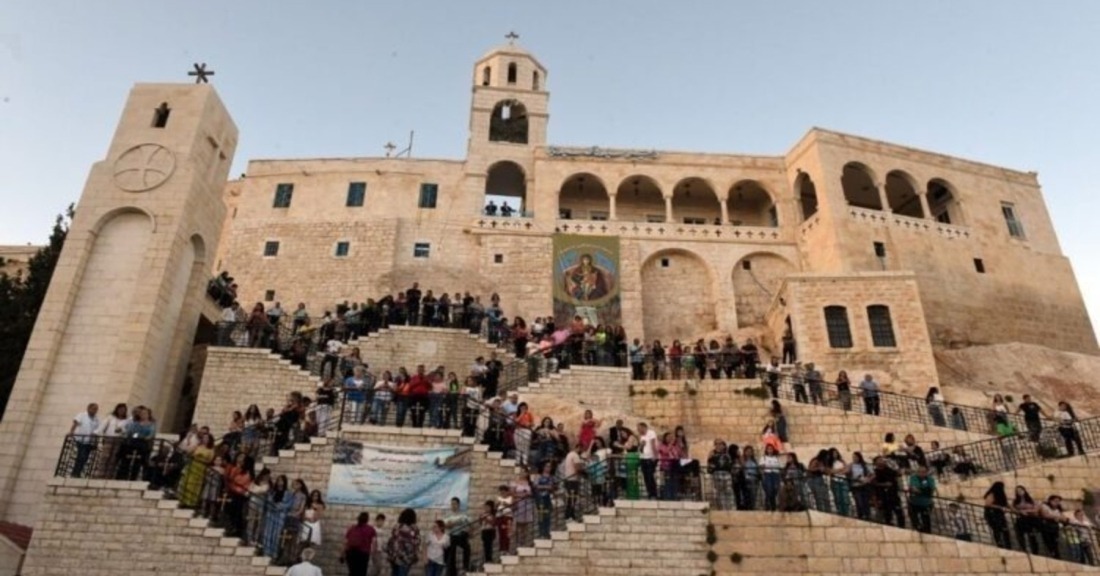
The great emperors of Romanía—from Constantine and the Theodosians to Justinian, Maurice, and Heraclius—not only organized an immensely powerful state, but fashioned an entire world. In the Levant they gave form to a distinctly Christian polity: they restored and elevated cities (Jerusalem, Bethlehem, Damascus, as well as the so-called “forgotten cities” of Apamea), they built monastic centers that became great spiritual hearths (Saint Sabbas, Saint Catherine, Our Lady of Saidnaya), and they raised churches that expressed the faith as a public and collective reality [the Church of the Nativity, the Church of the Resurrection, the Church of Saint John the Baptist in Damascus (now the Umayyad Mosque), and others]. These were not isolated works, but a conscious transformation of space: the entire region was integrated into a unified Romeic and Orthodox civilization, in which city, church, and monastery together formed a single way of life.
Beirut was not merely a city of the Levant, but one of the most important intellectual and institutional centers of Romanía. Its School of Law, equal in stature to that of Constantinople, shaped Roman law and contributed decisively to the formation of Justinian’s Code.
At the same time, the Levant emerged as a womb of sanctity and theology. From it came forth great figures of our Church, such as Saint John Chrysostom, Saint Romanos the Melodist, Saint John of Damascus, Saint Sabbas, Saint Barbara, Saint Thekla, Saint Cosmas the Melodist, Bishop of Maiuma, Saint Isaac the Syrian, and many others—saints who left their seal upon the faith, theology, and worship of the Church.
Here it becomes abundantly clear that the Levant was not a mere periphery, but a living core of our homeland, producing law, discourse, and sanctity—in other words, civilization in its fullness.
Islam in the Levant
In the seventh century, the Levant underwent a radical rupture: the Arab Islamic invasion. This new power, emerging from the Arabian Peninsula, appeared precisely at the borders of Romanía and soon conquered the provinces of the Levant.
Islam did not arise in a vacuum, but within an environment already marked by various Christian and Jewish currents. It was influenced, among other things, by movements denying the divinity of Christ, such as Arianism, as well as by Judaeo-Christian communities such as the Nazarenes, who regarded Christ as one sent by God, but not as God.
The arrival of the Muslims was not received uniformly: the Monophysites, already estranged from Romanía, often viewed them favorably, whereas the Orthodox perceived them as a new heresy, as Saint John of Damascus characteristically formulates it in his writings. Thus, the Islamic conquest was not merely a political change, but a profound alteration of the religious and cultural map of the Levant.
The Treatment of Christians by the Muslims – The Status of the Dhimmi
Dhimmi were the non-Muslims who were permitted to live under Muslim rule, but in a condition of inferiority. The status of the dhimmi did not constitute civic equality, but rather an institutionalized form of tolerated subordination. Non-Muslim populations, and especially the Romeoi, were allowed to retain their faith, but only on condition that they would not display it publicly and would not challenge the supremacy of Islam.
The dhimmi had:
• the right to perform religious services, provided they did not disturb Muslims,
• the right to own property and work, with the exception of professions reserved exclusively for Muslims (politics, the judiciary, teaching),
• the obligation to pay the jizya (poll tax) in exchange for protection, along with a prohibition on participating in military action against Muslims,
• a prohibition on displaying religious symbols (crosses, icons), on wearing distinctively Christian dress, and on publicly exhibiting places of worship,
• a prohibition on audible prayer outside churches,
• a prohibition on bell-ringing,
• a prohibition on building or repairing churches without Muslim permission,
• a prohibition on the “proselytizing” of Muslims (that is, evangelization),
• a prohibition on marrying a Muslim woman,
• a prohibition on inheriting from Muslims,
• and, in certain historical periods, an obligation to wear distinguishing Christian clothing, a ban on riding horses and camels, and an obligation to walk to the left of a Muslim in public spaces.
The so-called “protected” communities possessed rights only within predetermined limits, and their position always depended on the will of the authorities and on historical circumstances. Thus, the system’s “tolerance” was not equality, but a regulated and revocable concession.
What Happened after the Arab-Muslim Occupation of the Levant?
• 630–640: Arab Islamic invasion of the Levant.
• 640–1920: A succession of invasions and manifold alienation through foreign cultural influences:
o Intense Arabization and Islamization (Umayyads, Abbasids, Fatimids, Mamluks): the Greek language was replaced by Arabic; the dhimmi system was enforced.
o Crusades: Latinization.
o Ottomans (after 1516): the Millet system.
After the Arab conquest of the seventh century, the Levant entered a long period of transformations and successive impositions, which deeply altered its original Romeic identity.
Gradually, Arabization and Islamization prevailed: Greek, which had been the language of civilization and faith, gave way to Arabic, and the Romeoi were reduced to the status of dhimmi. This was not merely political domination, but a profound cultural mutation.
Subsequently, the Crusades brought about a new external intervention with strongly Latin characteristics, seeking to redefine the region in Western terms foreign to the Romeic tradition.
Finally, under Ottoman rule, an administrative system was consolidated which did recognize the Romeoi as a religious community, but definitively incorporated them into a framework of subordination and separation (Rum milleti).
During the Ottoman occupation, the condition of the Romeoi of the Levant improved in part:
• they re-established contact with the other Romeoi of Asia Minor and the Balkans,
• they were integrated into the millet system under the guarantee of the Ecumenical Patriarchate, and
• they were allowed to repair or erect new churches, maintain certain schools, and so forth.
The Major Consequences of Long Muslim Rule (13 Centuries)
The age-long occupation of the Levant led to a deep and gradual alteration of identity.
Arabization distanced the Romeoi from their natural body. Their living bond with Constantinople weakened, the Greek language receded from daily life and was largely confined to worship, while even personal names were gradually replaced by Arabic ones, marking a deeper cultural displacement.
At the same time, Islamization was extensive. Through the social and institutional pressures of the dhimmi system, many were driven en masse to change their faith, especially in urban centers. Churches were converted into mosques, public Christian presence was curtailed, and education was weakened, since Christians generally had no schools of their own.
Western Intervention and the Russian Role
During the Ottoman period, the Levant became a field of rivalry among foreign powers. The state alliances of Ottomans and Franks gave the Papal Church a privileged position, and it undertook systematic penetration through its notorious instrument, the Propaganda Fide (Sacra Congregatio de Propaganda Fide). This was a mechanism of Rome for the worldwide expansion of Papism, coordinating missionaries, schools, printing presses, and every possible means.
Thus, the Holy Places were placed under French “protection” (for roughly one hundred years); the Maronites became Catholic (1580); and, tragically, fractures appeared even within the Romeic body itself, as happened in the schism of 1724. At that point the Romeic body was divided between those who remained Orthodox Romeoi and the Unionists (Melkite Catholics, also called Uniates, from Unia, “Union”), who entered into communion with Rome.
From the beginning of the nineteenth century onward, a strong Protestant factor was also added, with missions from Prussia, England, and America seeking to reshape the identity of the local populations, through agencies such as the Church Missionary Society (London) and the American Board of Commissioners for Foreign Missions (New England).
In addition, nationalism was imported from the West as a tool for weakening and fragmenting the Ottoman Empire (many Romeoi adopted Arab or Syrian nationalism).
Within this framework, Russia also appeared many times as a counterweight. From the seventeenth century onward, it developed relations with the Patriarchates and intervened in pursuit of the protection of the Orthodox. Although its policy did not avoid mistakes—indeed, serious ones—Russia, through its wars with the Ottoman Empire, its diplomatic activity, and its broader involvement, contributed to ending French protection over the Holy Places, to the relaxation of the restrictions of the dhimmi system, and in large measure supported the reconstruction of the ecclesiastical and educational life of the Romeoi of the Levant.
Thus, the region was transformed into a field of conflict between West and East, with the Romeoi standing at the center of this geopolitical and spiritual confrontation.
Today, after the schism of 1724, the Romeoi are divided into two religious communities: the Orthodox and the Catholics (Papists). Correspondingly, there are two Orthodox Patriarchates (Antioch and Jerusalem) and one Catholic Patriarchate, whose jurisdiction covers the territories of the Patriarchates of Alexandria, Antioch, and Jerusalem.
After all this, it is a great historical wonder that the hundreds of thousands of Orthodox Romeoi of the Levant endured and continue to this day proudly and luminously to declare and defend their identity. We all owe them much, and above all our undivided respect and support.
We shall, however, return to the Romeoi of the Levant.
Ioannis K. Neonakis
Head of the Romeosyne Policy Department, NIKI